How Do You Spell Garden Correctly
Many people struggle to remember the correct spelling of everyday words, and “garden” is no exception—you’re not alone. If you’re looking for a simple way to spell garden correctly, here’s a quick guide to help.
You spell “garden” G-A-R-D-E-N. It has six letters: G, A, R, D, E, and N, in that order, and ends with “en.” You can remember it by splitting the word into two syllables: “gar-den.”
A garden is a place where you grow flowers, vegetables, herbs, or other plants.
The same spelling applies whether you’re using “garden” as a noun or a verb.
Keep going to learn its pronunciation, related forms, and common misspellings.
Key Takeaways
- Garden is spelled G-A-R-D-E-N.
- It has six letters: G, A, R, D, E, and N.
- The spelling breaks into two syllables: gar-den.
- Remember the final letters are E-N, not “I-N” or “O-N.”
- The same spelling applies whether *garden* is a noun or a verb.
How Do You Spell Garden Correctly?
You’ll see *garden* in everyday sentences and in gardening terminology. For example, you might write, “You can plant tomatoes in your garden,” or “Your garden needs regular watering.”
The word can also describe a place designed for enjoyment, such as a botanical garden or a community garden. When you’re unsure, check a trusted dictionary or spell-check tool, then read your sentence aloud to confirm that the word fits its context.
Don’t rely only on autocorrect: it may accept a word that doesn’t express what you intend. With a quick review, you can use *garden* confidently in messages, essays, and practical instructions.
What Letters Make Up “Garden”?
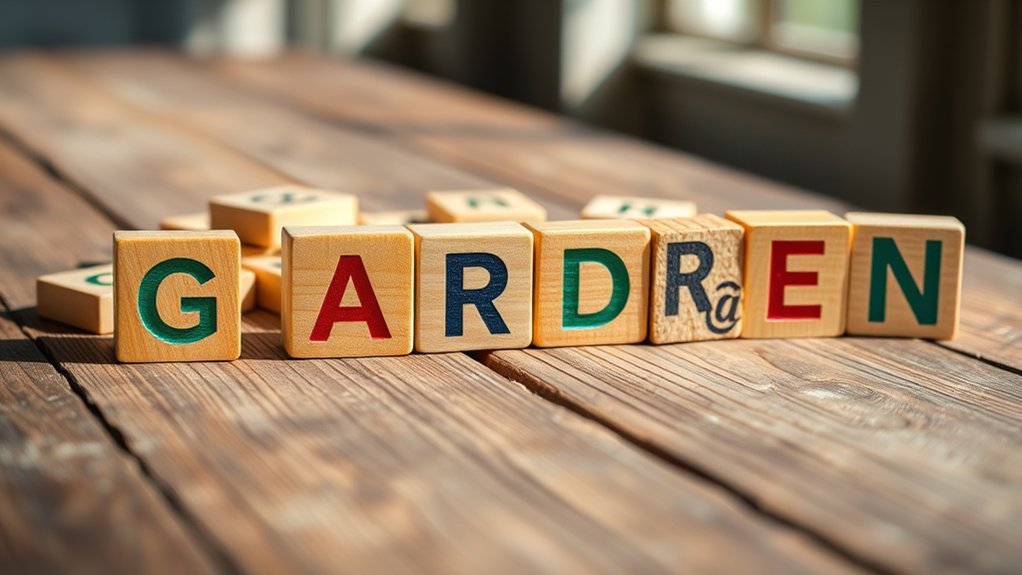
What letters make up *garden*? You spell it with six letters: G, A, R, D, E, and N. In order, they form G-A-R-D-E-N. The word begins with G, followed by A and R. D comes fourth, E comes fifth, and N closes the word. Each letter has a distinct place, so changing the order changes the spelling.
When you write *garden*, use one G and one of each remaining letter. Don’t add another A, drop the D, or swap the final N and E. The word’s pronunciation may help you recognize it, but the written form has a fixed sequence. You can also notice that *garden* contains two syllables, often spoken as “gar-den”; however, its spelling includes all six letters, not just the sounds you hear.
Knowing the letters gives you a clear answer about garden origins in writing and supports accurate spelling memory without relying on guesswork.
How Can You Remember the Spelling?
To remember how to spell *garden*, break it into two syllables: gar-den. Say each part slowly, then blend them: “gar” plus “den” makes *garden*. This simple rhythm helps you keep the letters in order.
Break *garden* into gar-den, say each syllable slowly, then blend them to keep the letters in order.
You can also connect the word to a familiar image. Picture a garden gnome beside a row of flowers. When you write the scene in a note or sentence, pause and recall the spelling: g-a-r-d-e-n. Repeating the word while you write it can strengthen your memory.
Try using *garden* in a short sentence about seasonal planting, such as, “You plan seasonal planting in your garden.” Cover the word, write it from memory, and check your spelling. If you miss a letter, correct it and try again. A quick review later can help the pattern stick.
With a little practice, you’ll spell *garden* confidently whenever you need it.
What Does “Garden” Mean?
A garden is a place where people grow flowers, vegetables, herbs, or other plants. You might tend a small patch beside your home, cultivate containers on a balcony, or visit a public garden filled with paths and flower beds. In each case, the space supports plant growth and gives you a place to enjoy nature.
The garden meaning can also include the land itself, not just the plants. For example, you may call a landscaped area a garden even when someone else cares for it. Some expressions use the word more broadly, such as “garden variety,” which means ordinary or common.
Understanding the meaning can help you connect the word to familiar places and activities. If you’re reviewing garden memory tricks, picture a garden you know and name what grows there. That image can reinforce the word’s meaning while helping you recall how to write it. A clear definition gives you useful context whenever you read or use “garden.”
How Do You Pronounce the Word?
How do you pronounce “garden”? You say it as two syllables: GAR-den. Put the emphasis on the first syllable, then say the second one lightly. In standard American English, the vowel in “GAR” sounds like the “ar” in “car,” while “den” rhymes with “when.” Your accent may change the vowel slightly, but the word’s two-part rhythm stays easy to recognize.
To pronounce it clearly, say each part slowly, then blend them together. You don’t need to add a syllable or stretch the final sound. These details can help you distinguish pronunciation from spelling: spelling pronunciation means saying a word exactly as its letters might suggest, even when common speech differs.
- Syllables: Break “garden” into gar and den.
- Stress: Emphasize GAR, not the ending.
- Practice: Repeat the word at a natural pace, keeping both syllables distinct.
If you’re collecting topic ideas for a spelling guide, a brief note about stress and syllables gives readers a useful pronunciation cue without distracting from the word’s spelling.
How Can You Use “Garden” in a Sentence?
Once you know how “garden” sounds, you can use it to name a place where plants grow or describe the act of tending one. In a sentence, give readers enough context to understand what you mean.
Use “garden” for a place where plants grow or the act of tending one, and add context to make your meaning clear.
For example, you might write, “Your garden needs water after a week without rain,” or, “You can garden on a balcony with containers.” These examples show how the word fits naturally into everyday conversation.
You can also use “garden” when you discuss shared spaces, food, or outdoor activities. Try, “The community garden provides fresh vegetables,” or, “Your urban farming project could begin with herbs in pots.”
If you’re writing instructions, say, “Keep garden etiquette in mind by respecting paths and asking before picking.” A specific sentence helps make your meaning clear. Read it aloud to check that “garden” sounds natural and that the surrounding words explain whether you mean a planted space or caring for plants.
Can “Garden” Be a Noun and a Verb?
Yes, “garden” can be both a noun and a verb. As a noun, it means a place where plants grow. As a verb, it means to tend or cultivate that space. The examples below show both uses in sentences.
Garden as a Noun
“Garden” works as both a noun and a verb. As a noun, it names a place where you grow flowers, vegetables, herbs, or other plants. You might picture a spacious backyard plot, a community growing space, or a few containers on a balcony. In each case, the word identifies the space itself, not an action.
You can use “garden” in everyday sentences:
- Your garden attracts bees and butterflies.
- The school garden gives students room to learn.
- Urban gardening lets you grow plants in limited space.
The noun also appears in familiar phrases, such as “garden gate” and “garden tools.” When you discuss garden etiquette, you’re referring to considerate behavior in a shared garden, not the garden’s spelling. Recognizing this noun use helps you choose the right meaning from context.
Garden as a Verb
| Word form | Function |
|---|---|
| garden | Noun: a cultivated space |
| garden | Verb: to tend or cultivate plants |
The garden pronunciation stays the same in both uses: /ˈɡɑːrdən/. Its garden etymology traces through Anglo-French and Germanic roots connected with an enclosed space. English later adopted the verb, so you can use *garden* for the work you do, too.
Examples in Sentences
- Noun: “The garden needs rain.” Here, garden names a place.
- Verb: “They garden together.” Here, it describes an activity.
- Both: “You garden in the garden.” The first garden is a verb; the second is a noun.
This grammar usage helps you choose the right meaning without changing the spelling.
What Are Common Misspellings of “Garden”?
You might misspell “garden” as “gardin” or “gardenn.” These mistakes can happen when you mishear the vowel or accidentally add an extra letter. Just remember the correct spelling—G-A-R-D-E-N—and you’ll be all set.
Common Misspellings
Common misspellings of “garden” include “gardin,” “gardon,” and “gardan.” These errors often come from mishearing the vowel sounds or guessing how the word ends.
When you write about a backyard plot, community space, or urban farming project, choose the standard spelling: garden. You can check your work by comparing each letter with the correct form.
- Gardin: Replace the final “in” with “en” to spell “garden.”
- Gardon: Use “e” rather than “o” in the second syllable.
- Gardan: Keep the middle vowel “e” and finish with “en.”
These variants aren’t accepted spellings, even in casual notes or signs. If you’re drafting a guide about garden etiquette, proofread the word before sharing it.
A quick dictionary check can help you present clear, polished writing.
Why Errors Happen
Why do writers misspell “garden” as “gardin,” “gardon,” or “gardan”? You may hear the word more often than you read it, so its unstressed final syllable can sound like “in” or “on.” When you rely on pronunciation alone, you might choose a vowel that seems plausible but doesn’t match the standard spelling. Fast typing can also lead you to hit a neighboring letter or leave out the “e,” especially when you’re focused on the sentence’s meaning.
Context can add to the confusion. If you’re writing about Garden etiquette or pest management, you may concentrate on the advice rather than the spelling of “garden.” Familiarity can make errors harder to notice, too: your mind often supplies the intended word, so a misspelled version may look correct at a glance.
Correct Spelling Tips
To avoid these sound-based and typing errors, remember that garden is spelled G-A-R-D-E-N, with an e in the final syllable. You might accidentally write “gardin,” “gardan,” or “gardnen” when you rush or rely only on sound. Check each letter before you submit your writing.
Use these strategies to keep the correct form in mind:
- Create a spelling mnemonic: picture a garden with six letters, ending in “den.”
- Apply pronunciation tips: say “GAR-den” slowly, then match each syllable to its letters.
- Proofread for common swaps: check that you haven’t replaced the first e with i or a, or added an extra n.
When you use garden in a sentence, pause briefly to verify its spelling. A quick review helps you catch errors without slowing your writing much. Practice the word in a short sentence, such as “Your garden looks lovely.”
How Do You Spell “Garden” in Related Forms?
When you make “garden” plural, add -s: “gardens.” For the past tense of the verb, add -ed: “gardened.” In each case, you keep the final n before the suffix. You don’t drop a letter or change the vowel.
Try grouping the forms together—garden, gardens, gardener, gardening, gardened—to notice the shared spelling pattern. This simple comparison helps you write each form accurately and recognize how a familiar word grows into related words. You can check the suffix, then confirm that the base remains intact.
Does British English Spell “Garden” Differently?
- Spelling: You write *garden* with the same six letters in both varieties.
- Pronunciation: You might hear differences in vowel quality or the final sound, depending on the speaker.
- Usage: You can use *garden* in either variety, though context may shape what a speaker means by it.
Keep spelling pronunciation links in mind: sound can vary while spelling stays fixed. If you’re writing for a British audience, *garden* remains correct.
Frequently Asked Questions
What Is the Origin of the Word “Garden”?
The origin of the word garden traces back to Old North French *gardin* and Anglo-French *gardin*, meaning an enclosed space for growing plants. These forms came from a Germanic root related to “yard” and “enclosure.”
You can follow the evolution of its spelling through Middle English forms such as *gardin* and *gardyn*, before English settled on *garden*. The word’s history reflects its original sense: a protected, cultivated plot.
What Is the Plural Form of “Garden”?
The plural of “garden” is “gardens.” You form it by adding -s because “garden” ends in a regular consonant sound. When you write about gardens, remember this simple rule to avoid errors.
What are common spelling mistakes with garden? You might accidentally write “gardenss” or “gardenes,” but neither is correct. Understanding pluralization rules for garden benefits your writing by helping you describe multiple outdoor spaces clearly and confidently.
Is “Garden” Used in Compound Words?
Yes, “garden” appears in compound words, and you’ll find examples everywhere—from “garden hose” and “garden party” to “vegetable garden.” It’s a word that could fill a million gardens!
You can also see it joined in forms like “garden-variety” and “garden-center,” though spelling and hyphenation depend on the term and style. For pronunciation tips for non native speakers, say “GAR-dən,” stressing the first syllable and keeping the second short.
What Are Some Synonyms for “Garden”?
Synonyms for garden include yard, plot, patch, grounds, and green space. You can also choose more specific words, such as flower bed, orchard, allotment, or conservatory, depending on the setting.
For example, an orchard grows fruit trees, while an allotment gives you a small space to cultivate crops. Related gardening terms include flowerbed, greenhouse, lawn, and border. Pick the word that best matches the garden’s purpose, size, and style.
How Do You Spell “Garden” in Other Languages?
How do you spell “garden” across languages? In Mandarin, it’s 花园 (huāyuán); in Spanish, jardín; in Arabic, حديقة (ḥadīqa).
You’ll find pronunciation tricky: Mandarin tones matter, Spanish’s j sounds like an English h, and Arabic’s ḥ is a deeper throat sound.
What about regional spelling variations? British and American English both use “garden”; other languages may vary by region, script, or transliteration. Check local usage when writing for a specific audience.
Conclusion
You spell garden G-A-R-D-E-N—six letters, one simple word, and somehow a surprising number of chances to get it wrong. Remember the spelling, and you can write about flowers, vegetables, or a peaceful backyard without stumbling over the word that names them.
Ironically, the easiest way to enjoy your garden may be to stop worrying about how to spell it. Keep the letters in mind, and you’ll spell garden correctly every time you write.